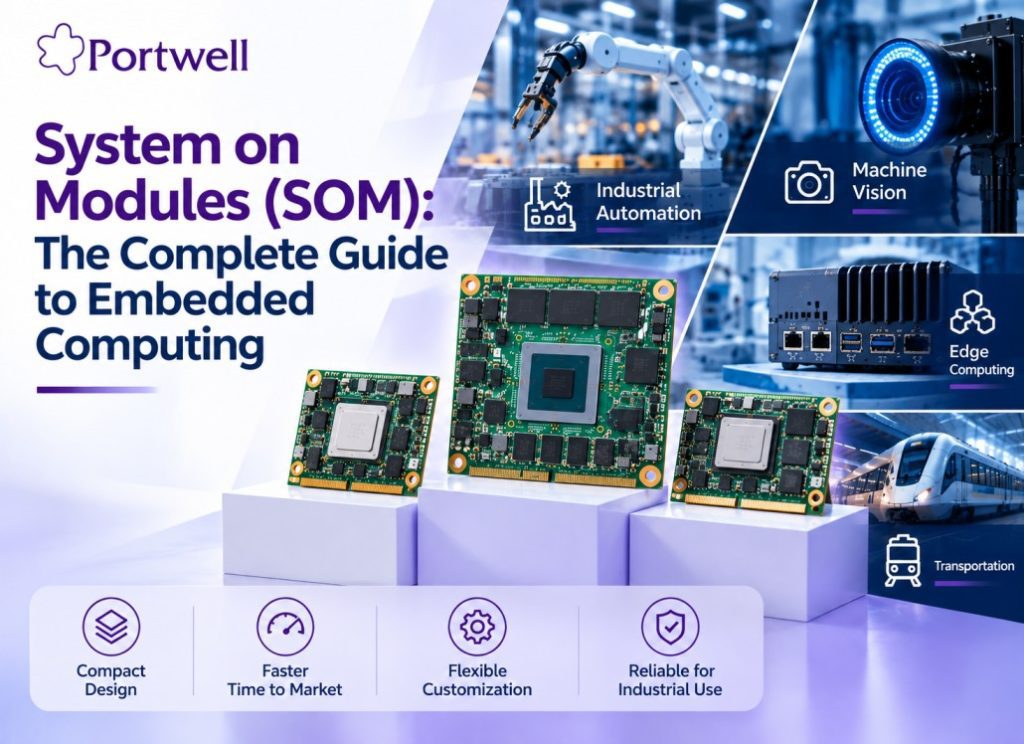
System on Modules (SOM): Complete Guide to Embedded Computing
Home / System on Modules (SOM): The Complete Guide to Embedded Computing Published On: 08 September 2026 Table of Contents A System on Module (SOM) also called a Computer on Module (COM) is a compact, production-ready circuit board that integrates a processor, memory, storage, power management, and core interfaces into one module. It plugs into a carrier board that adds the application-specific I/O, letting product teams build embedded systems faster without designing the entire computing architecture from scratch. Portwell designs and manufactures System on Modules including COM Express and Qseven form factors along with PICMG SBCs and industrial motherboards for OEMs building industrial, automation, and edge-computing products. What Is a System on Module (SOM)? A System on Module (SOM) sometimes called a Computer on Module (COM), as the two terms are used interchangeably in the industry is a compact embedded computing board that integrates the processor, memory, storage, and power circuitry needed to run an operating system and application software. A SOM may include: Processor or System on Chip (SOC) RAM Flash or eMMC storage Power management circuitry (PMIC) Graphics or AI acceleration (GPU/NPU) Ethernet and USB interfaces Wireless connectivity Security components High-speed communication interfaces Instead of designing these components individually onto a custom PCB, developers integrate a pre-engineered SoM into a carrier board built around their application separating the computing platform from the application-specific hardware. Quick Fact Box SOM: Computer on Module (COM) same concept but different name A SOM is not a Single Board Computer (SBC) as it needs a carrier board A SOM is not a System on Chip (SOC) instead one chip and a full board built around one How Does a System on Module Work? A SOM-based embedded system has three major parts: System on Module -> Carrier Board -> End Product. The SoM is responsible for computing, while the carrier board distributes the power and the signals to displays, sensors, and industrial I/O of the end product. For example, a machine vision inspection system that requires Ethernet, CAN, USB, and a display can use Portwell SoM (for computation) with custom-designed Carrier Board that handles those interfaces, avoiding a complete custom chip-down design and shortening the development time by months. As a result, this design allows the engineers to focus on the application-oriented features instead of developing the whole embedded computer from scratch. What Components Are Included in a System on Module? Component Function Common Options Processor / SOC Core compute ARM, x86, RISC-V based SOCs RAM Runs OS + apps LPDDR4 / LPDDR4X, DDR4 Storage OS + application data eMMC, NAND, NOR flash Power Management (PMIC) Regulates / distributes power PMIC-based circuits Connectivity I/O to carrier board Ethernet, USB, PCIe, CAN/CAN-FD, MIPI Acceleration AI / vision workloads GPU, NPU, DSP, FPGA Security Data / boot protection Secure boot, hardware security elements, secure storage SOM vs SOC vs SBC — What’s the Difference? A SOM is a compute module that requires a carrier board; a SoC is a single chip requiring full custom PCB design; an SBC is a complete, ready-to-use computer needing no carrier board. Most embedded product teams get the best balance of speed and customization from a SoM. Feature System on Module System on Chip Single Board Computer Definition Complete computing module Computing architecture integrated into a chip Complete computer on a board Processor Included Included Included Memory Often integrated May be integrated or external Included Carrier Board Usually required Custom PCB required Usually not required Customization High Very High Moderate Hardware Development Reduced Significant Low Time to Market Faster Longer Fast Best Suited For Embedded products Highly customized hardware Prototyping and complete systems SOM vs Chip-Down Design: Which Should You Choose? Choose a SOM for faster time to market, lower engineering cost, and lower hardware-expertise requirements. Choose chip-down design only for highly specialized, high-volume products where maximum hardware control justifies the added cost and time. Factor SoM-Based Design Chip-Down Design Development Effort Lower Higher Time to Market Faster Longer Initial Engineering Cost Generally lower Generally higher Hardware Customization High Maximum Hardware Expertise Required Lower Higher Design Flexibility High Very high Prototype Development Faster Slower Product Scalability High Depends on design Best Suited For Many embedded products Highly specialized / high-volume products SoM Form Factors: Edge Connector vs. Mezzanine vs. Solder-Down SoMs come in three main mechanical form factors — edge connector, mezzanine connector, and solder-down (SMD) each suited to different design and volume needs. Form Factor Characteristics Best For Edge Connector Widely used industry standard (e.g., COM Express, Qseven); larger footprint due to connector Standard industrial designs, easy field upgrades Mezzanine Connector More efficient use of board space than edge connectors Space-constrained designs needing swappability Solder-Down (SMD) Mechanically robust, low profile, suited to automated assembly High-volume production, rugged/vibration-heavy environments Portwell’s COM Express and Qseven modules use industry-standard edge-connector form factors, giving OEMs a proven, pin-compatible upgrade path across processor generations. Real-World Applications of System on Modules SoMs provide processor boards for a variety of industries requiring computing solutions that are compact, reliable, and can be deployed in the field. Industrial Automation and Robotics SOMs are enabling PLCs, robot controllers, and other factory automation systems requiring real-time processing and rugged components the main focus in the Portwell industrial PC line and embedded box PCs. Machine Vision and Quality Inspection SOMs with a GPU/NPU on board can process images directly on the device, which is key for defect detection, inventory inspection, and signature analysis on the manufacturing lines where any delay would not be acceptable. IoT Gateways and Edge Computing SOMs powered with different wireless technologies are collecting the sensor data and processing it locally before transferring to the cloud, which allows reducing costs and latency due to lower usage of bandwidth. Medical and Diagnostic Devices SOMs are compact and low-power solutions for any patient monitoring devices and diagnostic equipment where reliability and availability of parts for extended time period are essential. Transport and Kiosks Industrial panel PCs and displays built around SOM/SBC technologies drive digital signage, ticket vending machines, transport systems,
System on Modules (SOM): Complete Guide to Embedded Computing Read More »