SMARC
SMARC Modules (Smart Mobility ARChitecture) for Low-Power Embedded Systems
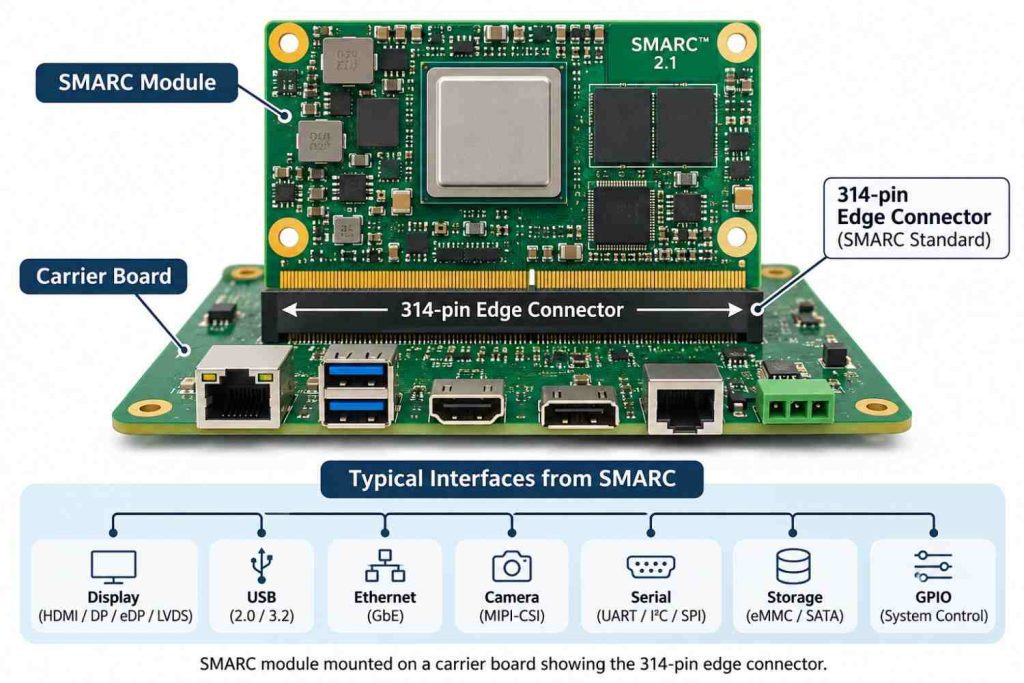
A SMARC module is a credit-card-sized computer-on-module that puts the processor, memory and core controllers on one small board. You plug it into a carrier board that carries your own connectors and interfaces. Portwell India offers SMARC modules with Intel and NXP i.MX processors, plus carrier boards for evaluation and design.
What is a SMARC module?
SMARC is a computer-on-module standard from the Standardisation Group for Embedded Technologies (SGeT), published as specification SDT.01. It defines the module size, the edge connector and the signals, so a module from one vendor fits a carrier board designed to the same revision.
The standard covers both ARM and X86 processors, and the design target is low power, small size and good graphics and I/O. Typical modules run at under 6 W, although higher-performance x86 modules can draw more, so always check the datasheet.
SMARC modules suit products such as industrial HMIs, medical devices, edge gateways, transportation systems and handheld equipment, where a custom board needs a proven compute core.
SMARC at a glance
Standard | SGeT SMARC (SDT.01); current revision SMARC 2.2 |
Module sizes | 82 mm × 50 mm (short) and 82 mm × 80 mm (full) |
Connector | 314-pin edge connector, 0.5 mm pitch, right-angle (sometimes called 321-pin because 7 pins are lost to the key) |
Processors | Arm (for example NXP i.MX) and x86 (for example Intel Atom, Pentium, Celeron) |
Typical power | Under 6 W for the standard’s target; varies by module |
What sits on the module | CPU, DRAM, boot flash, power sequencing and key controllers such as Gigabit Ethernet and display output |
What sits on the carrier | Application connectors, audio codec, touch controller, wireless, expansion slots |
Portwell options | SMARC 2.0, 2.1 and 2.2 modules |
SMARC Modules and Carrier Boards
- Module
- Carrier
How does a module and a carrier board work together?
Requirement | Consider | Reason |
Lowest power, battery or fanless operation | Arm (i.MX) | Efficient SoCs designed for low-power devices |
On-chip AI acceleration | Arm with NPU, such as i.MX 8M Plus | An integrated neural processing unit speeds up inference on the module |
x86 software compatibility or Windows IoT | Intel Atom, Pentium or Celeron | Same instruction set as existing x86 software and tools |
Rich display, I/O and PCIe expansion | Either; check the module’s interface list | Interfaces vary by processor and module |
Newest standard revision | SMARC 2.2 modules | Latest SGeT revision |
How does SMARC compare with other computer-on-module standards?
Standard | Typical size | Best for |
SMARC | 82 × 50 mm or 82 × 80 mm | Compact, low-power designs with strong display, camera and I/O needs |
70 × 70 mm | Small, low-cost designs with a fixed, smaller interface set | |
95 × 95 mm | Higher-performance x86 designs | |
125 × 95 mm | Highest-performance x86 designs with extensive PCIe |
How to choose a SMARC module?
- Processor and performance: Arm or x86, core count, AI needs.
- Power and thermal budget: typical and peak power, passive cooling or heat spreader.
- Memory and storage: RAM size and type, onboard eMMC or flash.
- Display and camera: LVDS, eDP, HDMI, DisplayPort, MIPI-DSI and MIPI-CSI needs.
- I/O: Ethernet, USB, PCIe lanes, CAN, UART, SATA.
- Operating temperature: commercial or extended range.
- Software: OS, BSP and driver availability.
- Standard revision: SMARC 2.0, 2.1 or 2.2, and carrier compatibility.
- Mechanical fit: module size, heat spreader, enclosure limits.
- Lifecycle: longevity commitment and end-of-life policy.
- Support: design-in help, carrier review and local engineering.
Carrier boards and design-in support
Every SMARC module needs a carrier board. Start with an evaluation carrier to test your software and I/O, then move to a custom carrier built for your product. SGeT also publishes a carrier design guide for the standard.
Where SMARC modules are used
- Industrial automation: HMIs, controllers and gateways
- Medical devices: portable diagnostic and patient monitoring equipment
- Transportation: in-vehicle systems and rail equipment
- Edge computing and IoT: gateways and edge AI devices
- Digital signage and kiosks
- Robotics and handheld equipment
Why Portwell India
Portwell is a global embedded computing provider, and Portwell India supports customers from Bengaluru.
- Contact: +91 95917 46660
- enquiry@portwell.in
- 3rd Floor, Jeet Dynasty, Old Madras Rd, Nagavarapalya, Bengaluru 560093
Frequently Asked Questions About SMARC Carrier Boards
A SMARC module is a small computer-on-module that integrates the processor, memory, and core controllers on one board, following the SGeT SMARC standard. It plugs into a carrier board that provides your application’s ports and interfaces, so you build a product without designing the compute core from scratch.
SMARC stands for Smart Mobility Architecture. It is a computer-on-module standard maintained by the Standardisation Group for Embedded Technologies (SGeT).
SMARC defines two sizes: 82 mm × 50 mm (short) and 82 mm × 80 mm (full). The short size suits space-constrained designs, while the full size gives room for higher-performance processors and cooling.
SMARC modules use a 314-pin edge connector with a 0.5 mm pitch, right-angle. Some documents call it a 321-pin connector because seven pins are lost to the key. Check the SGeT specification for the pinout.
A carrier board is the application-specific baseboard that a SMARC module plugs into. It holds connectors such as Ethernet, USB, and display ports, power input, and other interfaces. Evaluation carriers help you test, and custom carriers fit your final product.
They are successive revisions of the SGeT standard, and 2.2 is the latest. A module and a carrier should target the same revision, so confirm compatibility before you design.
It depends on the product. SMARC fits compact, low-power designs with strong display and I/O needs. COM Express serves higher-performance x86 designs. Qseven is smaller and older, with a more limited interface set. Choose by power, size, performance and interface requirements.
Portwell offers Intel-based modules (including the SMARC 2.2 PCOM-BC00 and SMARC 2.1 PSMC-M31, PSMC-M21 and PSMC-M1014) and NXP i.MX modules such as the PSMC-M840 and PSMC-M640F. Contact Portwell India for current availability.
Yes. The PSMC-M840 is a SMARC module based on the NXP i.MX 8M Plus processor.
List supported operating systems per module. For example, Arm modules commonly run Linux or Yocto-based images, and x86 modules can run Linux or Windows IoT. Confirm for each Portwell model.
Yes or no, with details. Confirm carrier design review, BSP support and custom or ODM options
Describe sample and evaluation options, lead times and how to request them.
State the longevity commitment per module family and how end-of-life notices work. Confirm before publishing.
Yes, SMARC modules are widely used in industrial automation and medical devices because of their small size, low power and long-life availability. Check each module’s temperature range, certifications and lifecycle commitment against your project requirements.
Use the Request a quote form on this page, call +91 95917 46660 or email enquiry@portwell.in with your processor, memory, interface and volume requirements.