
COM Express Module Types: Form Factors and How to Choose
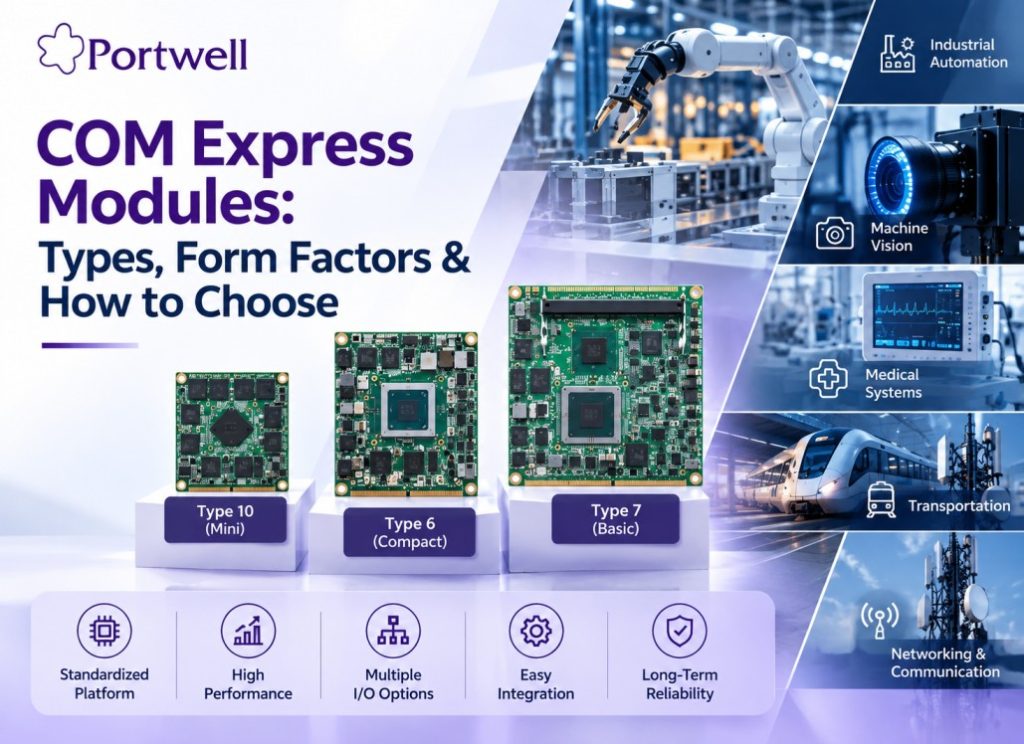
Home Blog COM Express Modules COM Express Modules: Types, Form Factors and How to Choose Published On: 07 September 2026 Table of Contents What Is a COM Express Module? COM Express is a Computer-on-Module (COM) standard that places the main computing functions on a compact module. These functions can include the processor, memory, graphics and core I/O interfaces. The module connects to a carrier board, which provides application-specific I/O, connectors and system expansion. This modular design allows OEMs and system integrators to build embedded systems around a standardized computing platform. How Does A COM Express Module Work? A COM Express System has two main parts: COM Express Module The module provides the main computing functions, including the processor, memory and core interfaces. Carrier Board The carrier board provides the application-specific connections, I/O ports and expansion needed by the system. Together, the COM Express module and carrier board form a complete embedded computing platform. The standardized design also gives OEMs more flexibility. When a new processor or computing platform is needed, the module can often be upgraded without redesigning the entire carrier board. Ready to Find the Right COM Express Module? Explore COM Express Modules COM Express Type 6 vs Type 7 vs Type 10 COM Express Type 6, Type 7 and Type 10 are designed for different computing, I/O and size requirements. COM Express Type Form Factor Typical applications Type 6 Balanced processing, graphics, and general I/O Industrial automation, HMI, robotics, machine vision, edge computing Type 7 High-speed networking and high-bandwidth I/O. Edge servers, network appliances, communication systems, high-throughput computing. Type 10 Compact Mini form factor for space- and power-constrained designs Space-constrained embedded systems where footprint matters more than raw I/O count COM Express Form Factors COM Express Type Form Factor Actual Size Type 10 Mini 55 × 84 mm Type 6 Compact 95 × 95 mm Type 7 Basic 95 × 125 mm What Is a COM Express Carrier Board and Why Is It Important? A COM Express carrier board connects the COM Express module to the rest of the system. The carrier board can provide: Application-specific I/O Connectors Storage interfaces Networking interfaces Display connections Expansion options Carrier board design also depends on the COM Express type. For example, a Type 6 carrier board is designed around the Type 6 pinout and its graphics and general I/O capabilities. A Type 7 carrier board is designed for the different I/O and high-speed networking requirements of Type 7. Therefore, a carrier board designed for one COM Express type is not automatically compatible with another type. COM Express vs COM-HPC, Qseven and SMARC COM Express, Qseven, and SMARC are Computer-on-Module standards designed for different performance, size and power requirements. COM Express provides a broad range of performance and I/O options, while Qseven and SMARC are commonly used where smaller form factors and lower power consumption are important. COM-HPC is a higher-performance PICMG Computer-on-Module standard designed for applications requiring greater I/O bandwidth and power than COM Express can provide. COM-HPC complements rather than simply replaces COM Express, making the two standards relevant to different system requirements. COM Express connector can deliver, while COM Express remains the broader, more established standard for current industrial and embedded designs. How to Choose the Right COM Express Module? Choosing a COM Express module starts with the application and workload. From there, evaluate processor performance, memory, I/O, power, thermal requirements, form factor and carrier-board compatibility. Processor In selecting a processor, it is important to consider its performance characteristics. It is important to analyse such factors as the processor generation, number of cores, graphics performance, and specific applications like industrial automation, machine vision, and edge computing. Memory It is essential to determine the type, size, and configuration of memory. By and large, this will be dictated by the operating system, applications, and processing needs. I/O Interfaces It is necessary to define the I/O interfaces to which peripheral devices will be connected. In this regard, PCIe, USB, SATA, Ethernet, and video interfaces are worth considering. Power It is always critical to compare power performance and budget since a given module will have power requirements that must be matched by the system power budget. This factor is closely related to the power draw of the processor. Thermal It is essential to understand the operating thermal budget in advance as some times, the industrial applications require cooling infrastructure. Form Factor It is always critical to consider the COM Express form factor in relation to the space allocated to the module. For instance, mini, compact, and basic modules have different physical dimensions. Carrier Board It is essential to select a module that is compatible with the given carrier board. In this regard, the pinout of the connector and the interfaces that need to be supported are also worth considering. Not sure which module fits your application? Talk to a COM Express engineer Which Portwell COM Express Modules Are Available? COM Express modules are used in applications where OEMs need a flexible and scalable computing platform. Common applications include: Industrial automation and robotics Machine vision and industrial HMI Edge computing and Edge AI systems Medical equipment Transportation systems Networking and communication systems, particularly network appliances built on Type 7 Defence and Aerospace Which Portwell COM Express Modules Are Available? Portwell offers COM Express Type 6, Type 7 and Type 10 modules across different processor platforms, form factors and performance levels. The complete portfolio includes modules for industrial automation, machine vision, edge computing, networking and other embedded applications. Product Module Type Processor / Platform Key Features Action PCOM-B65A COM Express Type 6 Basic Module Intel® Core™ Ultra 200 Series DDR5 · PCIe Gen 4 · USB 3.2 · 2.5GbE View Product PCOM-B658VGL COM Express Type 6 Basic Module Intel® 12th / 13th Gen H/P/U Processor DDR5 View Product PCOM-B659 COM Express Type 6 Compact Module Intel® 13th Gen P/U Processor DDR5 · PCIe Gen 4 · USB4 · 2.5GbE View Product Looking for more COM Express modules? View All COM Express Modules Why Choose
COM Express Module Types: Form Factors and How to Choose Read More »